
Flybi / Services / Structural Inspection
Service · Structural Inspection
Inspect the unreachable. Without the scaffolding, without the outage.
RGB, thermal, and LiDAR drone inspection of chimneys, flare stacks, cooling towers, bridges, dams, silos, transmission towers and process plant. Georeferenced defect maps delivered as an engineering report your asset-integrity team can act on.
The problem
Conventional inspection is slow, dangerous, and half-blind.
A rope-access inspection of a 200m chimney costs a week of downtime, a five-figure mobilisation, and still leaves the top of the stack inspected by eye. A ladder survey of a cooling tower covers one cell at a time. Bridges are inspected by rappelling teams who see one square metre every few minutes. The result: small defects become large ones before anyone sees them.
Every year, asset-integrity teams explain to boards why a failure "came from nowhere" — when the data was simply never collected.
The solution
A drone captures what a human can't — and does it in a morning.
- Full asset coverage. High-resolution RGB imagery at 1–2 mm/px ground resolution over the entire visible surface of the asset — every cell, every weld, every fastener.
- Thermal delta map. Calibrated IR imagery co-registered with RGB. Hotspots, moisture ingress, and refractory damage visible as deltas — not impressions.
- LiDAR where warranted. Sub-centimetre point clouds for deformation analysis and clash detection on complex geometry.
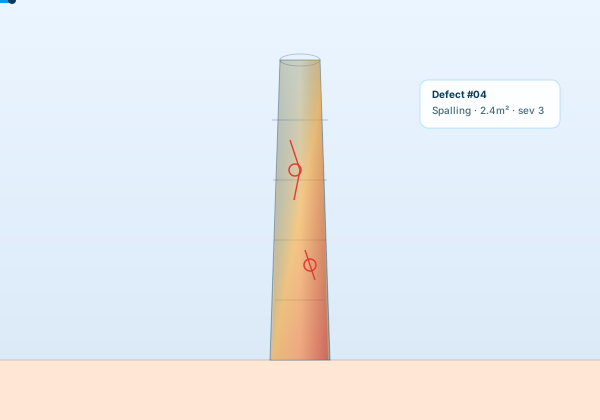
- Defect catalogue. Every defect classified (cracking, spalling, corrosion, thermal anomaly), severity-scored, geotagged, and linked back to a photograph — not a paragraph.
- Comparable re-flight. Same flight plan, same altitude, same camera — so next year's inspection is change-detected, not re-estimated.
What you receive
Deliverables
What your inspection engineer, your asset-integrity lead, and your insurer each need — in the format each of them will actually read.
Engineering report
A structured PDF with executive summary, defect register, severity ranking, photographic evidence, and recommended corrective actions.
3D orthomodel
Textured 3D model of the asset, navigable in browser, with every defect pinned as a clickable annotation.
Raw data archive
RGB photographs, IR frames, and LiDAR .las files — yours to keep, re-analyse, or hand to a third party.
Change-detection baseline
A locked flight plan and reference dataset so next inspection is a delta, not a re-measurement.
How it runs
A clean four-stage engagement
- Scope30-minute call to understand the asset, access constraints, operating window, and what "defect" means for your use case.
- Fly1–3 day mobilisation. Survey completes in hours, not days. No scaffolding, no outage, no confined-space permit.
- AnalyseOur structural engineers classify and score every defect. No AI hallucinations — every call is human-reviewed.
- DeliverReport + 3D model + raw archive. Optional on-site walk-through with your engineering team.
Have an asset you haven't inspected in over a year?
Tell us which one. We'll send back whether a drone inspection is a fit — and what it would cost to run.