
Flybi / Services / AeroMagnetic Intelligence
Product 01 · AeroMagnetic Intelligence
See through the ground, without drilling it.
Drone-borne aeromagnetic surveys for mineral exploration, geological mapping, and structural interpretation — delivered with sub-nT magnetic resolution, at a fraction of the cost and timeline of fixed-wing alternatives.
The problem
Exploration spend is disproportionately concentrated on the wrong holes.
Early-stage exploration decisions — where to drill, how deep, in what orientation — are still made, in many operations, on the basis of surface mapping and legacy regional geophysics. The result is predictable: high-cost drilling campaigns with low hit-rates, and structural surprises that emerge only after tens of crores have already been spent.
Satellite-derived and fixed-wing aeromagnetic products are too coarse to de-risk a specific block. Ground magnetic surveys are too slow to cover one. There’s a gap between "regional context" and "drill-ready targets" — and drone magnetometry is what fills it.
The Flybi solution
Engineering-grade magnetic data, production-quality interpretation.
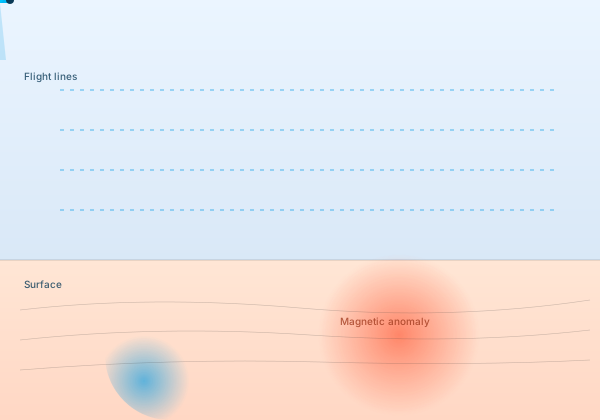
We fly drone-mounted cesium-vapour or fluxgate magnetometers at 30–60 metre terrain-following altitudes over blocks from 1 km² to a few hundred km², process the data through a hardened geophysical pipeline, and deliver a ranked drill-target memo — not a data dump.
Capture
Terrain-following, low-altitude
Pre-planned flight lines with automated terrain-following. Line spacing tuned to target type and depth. Ground-based base-station for diurnal correction on every mission.
Process
Hardened geophysical pipeline
IGRF removal, diurnal correction, heading-error compensation, tie-line levelling, micro-levelling. Every step is versioned, reproducible, and metadata-stamped.
Interpret
Geologist-signed outputs
Reduced-to-Pole, Analytic Signal, First Vertical Derivative, Euler depth-to-basement. Structural lineaments digitized. Drill targets ranked with confidence scores.
Under the hood
The technical spec, simplified.
Sensor
Cesium-vapour / Fluxgate magnetometers
- Sub-nT total-field sensitivity
- 1,000 Hz sampling rate
- Compensated for platform magnetic signature
- Synchronized to drone RTK GNSS
Platform
Type-certified drone carriers
- Terrain-following LiDAR / radar altimeter
- 30–60m AGL flight altitude
- 25–100m line spacing per target class
- DGCA / regulated-airspace compliant
Processing
Geophysical pipeline
- IGRF removal & diurnal correction
- Heading-error & lag compensation
- Tie-line levelling + micro-levelling
- Grid at 1/4 to 1/5 of line spacing
Interpretation
Decision-grade derivatives
- TMI, RTP, Analytic Signal, 1VD
- Tilt derivative & horizontal gradient
- Euler deconvolution (depth solutions)
- Structural interpretation & target ranking
Deliverables
What lands in your shared drive.
/01
Gridded data
TMI, RTP, Analytic Signal, 1VD, Tilt derivative — delivered as GeoTIFFs + Oasis montaj grids.
/02
Interpretation maps
Structural lineaments, magnetic domains, inferred geology — as georeferenced PDFs and shapefiles.
/03
Depth solutions
Euler depth-to-source solutions, with confidence radii. Depth-to-basement model as a contour grid.
/04
Drill target memo
Ranked targets with UTM coordinates, inferred geometry, recommended drill hole plan, rationale, and confidence score.
/05
Raw & QC data
Line-data CSV, base-station records, corrections log, processing report. Full audit trail for peer review or QP sign-off.
/06
API / GIS feed
Direct hand-off into your internal GIS — ArcGIS, QGIS, Leapfrog — via vector tile or WMS endpoint on request.
Commercial impact
The exploration-economics case.
Typical outcome: a block that would have taken six weeks of ground magnetic survey (or been priced out of a fixed-wing campaign entirely) is delivered end-to-end in three to four weeks — with data sharp enough to drill on, not just to orient the next survey.
Flybi vs alternatives
Why an exploration manager picks Flybi.
Flybi delivers
- A ranked drill-target memo, not raw grids
- Data reconciled against known ground truth (borehole, outcrop, QP review) before sign-off
- Reproducible pipeline with full audit trail — defensible in QP / JORC reviews
- Single point of ownership from flight plan to interpretation
- Ability to re-fly at sub-nT resolution as targets mature
Most alternatives ship
- A geophysical dataset and a separate interpretation bill
- Legacy data and "best effort" corrections — no ground truth
- Black-box processing with no reproducibility
- Fragmented handoffs across survey, processing, interpretation vendors
- Resolution ceilings set by fixed-wing altitude
Answers
Common questions on aeromagnetic deployments.
What block size is ideal for drone aeromag?
How deep do anomalies resolve?
Can you operate in restricted or sensitive airspace?
Do you provide interpretation or only data?
Can Flybi combine aeromagnetic with other sensors?
Scope your block
Send us the block. We’ll send back a plan.
Tell us about the geology, the target type, and the timelines. Within 48 hours you’ll have a scoped survey plan — line spacing, sensor selection, mobilization schedule, and a commercial envelope.